AI Reads, Code Writes: Why Deterministic Architecture Matters (2026)
Why the safest dental AI systems separate language-model interpretation from deterministic execution — and what to ask any vendor about where that line sits in their product.
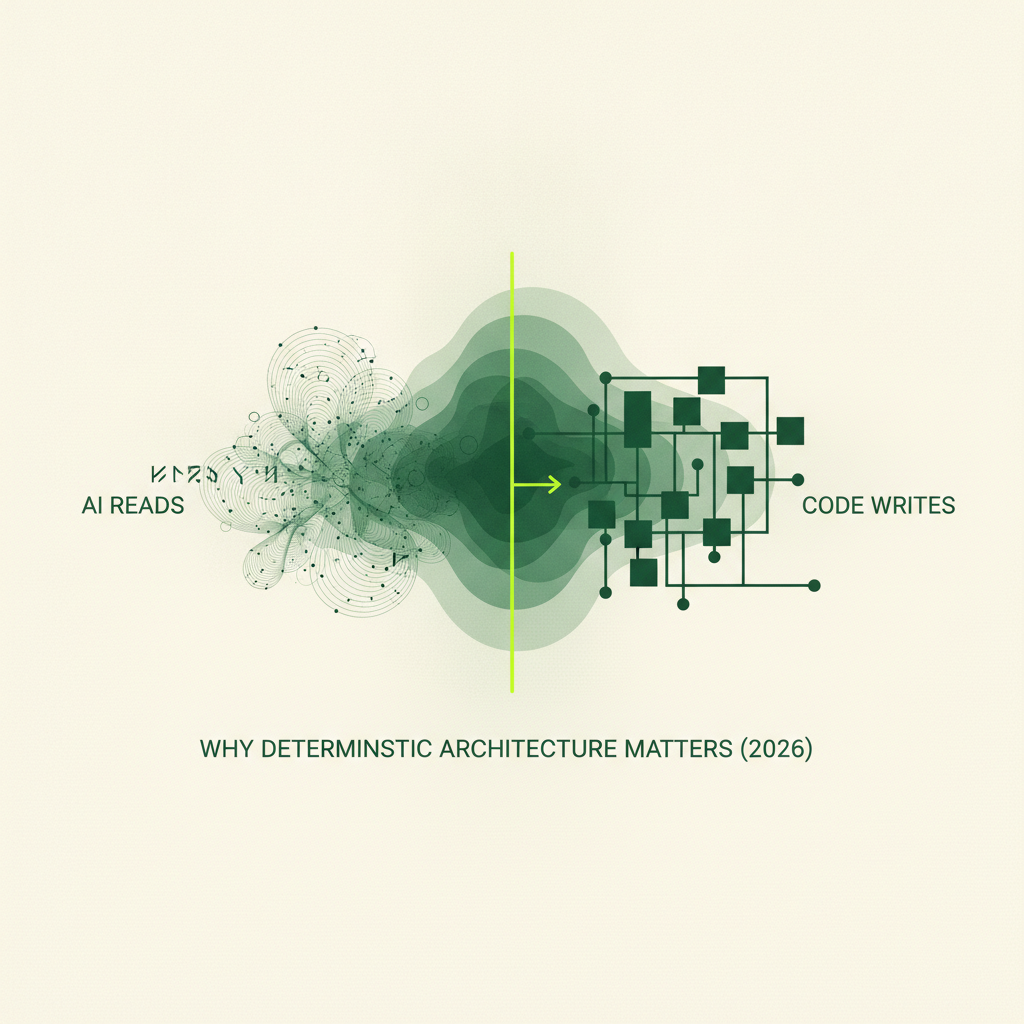
The safest and most trustworthy dental AI systems draw a hard line between two kinds of work: language models interpret ambiguous inputs and draft language for review, while every calculation, every claim field, every state change, and every dollar moved runs through deterministic code that a person can trace, test, and audit. Call this "AI reads, code writes." It sounds like an engineering detail. It's actually the single most important design decision separating dental AI that's trustworthy with money and medical records from dental AI that occasionally, unpredictably, isn't — and it's a question worth asking every vendor in this category, including us.
Key takeaways
- Language models have a well-documented failure mode — confidently producing plausible but incorrect output — that no amount of prompting eliminates.
- In a dental practice, confidently wrong output applied to a copay, a claim field, or a medication list isn't a bad user experience; it's a financial loss, a compliance exposure, or a patient-safety event.
- The fix isn't avoiding AI — it's architecturally confining where AI output can directly cause an action, versus where it must pass through validation first.
- "AI reads" means: interpreting scanned documents, phone transcripts, and free text, and drafting human-facing language for approval.
- "Code writes" means: every calculation, every database write, every claim segment, every state transition is deterministic, testable, and reproducible.
- This isn't a limitation on AI capability — it's where AI capability gets deployed for maximum value with the risk contained.
Contents
- The failure mode this architecture exists to prevent
- What "AI reads" actually means
- What "code writes" actually means
- The boundary in practice: a denial, worked through the lens
- Why this isn't just caution — it's better engineering
- Where the boundary gets tempting to blur
- What this doesn't mean
- How to test whether a vendor actually follows this
- How Omnira enforces this boundary
- Frequently asked questions
- The bottom line
The failure mode this architecture exists to prevent
Large language models have a specific, well-documented, and — importantly — irreducible failure mode: they can produce output that is fluent, confident, and wrong. Not obviously wrong in a way that trips an alarm. Plausibly wrong, in a way that looks like every other correct output the model produces, right up until someone checks.
This isn't a bug that better prompting fixes, and it isn't unique to any particular model or vendor — it's a structural property of how these systems generate text, and it persists even as models get more capable. A more capable model is wrong less often. It is not wrong never, and it doesn't announce which outputs are the wrong ones.
In most software categories, this failure mode is an annoyance. A wrong suggestion in a writing tool gets caught by the writer. A wrong summary in a research assistant gets caught by someone checking the source. In a dental practice, the equivalent failure lands somewhere with real consequences: a wrong copay calculation is money mishandled at the front desk. A wrong field on a claim is a denial, or worse, an incorrect submission that creates a compliance question. A wrong entry near a medication list is a patient-safety issue. The cost of being confidently wrong scales with what the output touches — and in a dental practice, a lot of what software touches is money and medical records.
This is the actual engineering problem that "AI reads, code writes" solves. Not "AI is untrustworthy" — AI is extremely good at exactly the things it's good at. The problem is that nothing about a language model's output tells you, reliably, when it's one of the wrong ones. So the architecture has to assume every output might be wrong, and design around that assumption rather than around the false assumption that a good enough model eventually stops being wrong.
What "AI reads" actually means
Two jobs, and only two, belong to the language model in a well-architected dental AI system:
Interpreting ambiguous inputs. A scanned paper explanation of benefits with a coffee ring on it. A phone call transcript full of half-finished sentences and cross-talk. A patient's free-text message: "my tooth is killing me and I think the crown thing came off." A clinician's dictated note. These are genuinely ambiguous — the information is there, but it's not in a structured, predictable format, and traditional rule-based software has always struggled with exactly this kind of input. Language models are remarkably good at it, which is the real breakthrough this technology brought to administrative work.
Drafting human-facing language for review. An appeal narrative built from clinical facts. A message to a patient explaining a denial. A suggested clinical note structured from a dictation. In every one of these cases, the model's output is a draft — visible, editable, and requiring a human decision before it becomes anything more than a draft.
Notice what both jobs have in common: the model's output is either immediately validated by code, or immediately presented for human approval before it can cause anything to happen. It's never both unvalidated and directly consequential at the same time.
What "code writes" actually means
Everything else — and it's most of what a dental practice's software actually does — runs as deterministic code: software that produces the same output from the same input, every time, and that can be tested, audited, and proven correct in a way a model's output cannot.
Every calculation. A copay, a remaining benefit, a contractual write-off, a patient balance. These are arithmetic operations with exactly one correct answer given the inputs, and arithmetic is something code does perfectly and a language model does approximately — approximately is not good enough for a number that ends up on a bill.
Every claim field. Which CDT code, which tooth, which frequency indicator, which reference qualifier. Building an insurance claim is filling out a form with strict, well-defined rules — precisely the kind of task deterministic code excels at and where a model's occasional creativity is actively dangerous.
Every classification that has real consequences. Whether a denial is a documentation problem or a coordination-of-benefits offset. Whether a procedure requires prior authorization. These look like they require judgment, but they're actually lookups against known rules — and treating them as lookups, in code, against explicit rule tables, is both more accurate and more auditable than asking a model to reason about them fresh each time.
Every state transition. A claim moving from submitted to denied to resubmitted to paid. An appointment moving from scheduled to confirmed to completed. These are the practice's actual operational history, and that history needs to be reliable and reconstructable — which means it's generated by code following explicit rules, not by a model's best guess at what probably happened next.
The boundary in practice: a denial, worked through the lens
Abstract principles are easier to trust when you can see them applied. Here's a documentation denial — a payer wants a radiograph before it'll pay a crown claim — worked through the reads/writes boundary explicitly.
AI reads: If the denial arrived as a scanned paper explanation of benefits rather than a clean electronic remittance, a model interprets the scan into candidate structured values — the codes, the amounts, the reason. This candidate output does not go straight into any system. It's validated: do the codes exist in the reference tables, do the amounts reconcile to the document's stated total? Only validated output proceeds.
Code writes: The denial reason code is looked up in a rule table — not interpreted by a model — which determines this is a documentation-required denial and specifies which document type the procedure and payer combination calls for. Code retrieves the correct radiograph from the imaging record by matching tooth number and date proximity. Code constructs the replacement claim: the correct frequency code, the payer's claim control number pulled from the original remittance, a fresh claim identifier.
AI reads (again), for one specific sub-task: A narrative justifying the treatment is drafted — real writing, which is a legitimate language-model task — using only the structured chart facts already established: the procedure, the tooth, the diagnosis, the clinical findings. The model does not invent facts; it composes language from a fixed set of inputs.
Back to a human: The narrative is presented for approval, with the source of each factual claim visible. Only after a person approves does anything transmit.
Code writes (again): Once approved, code assembles and transmits the actual documentation package and the replacement claim, using the exact mechanics — frequency code, control number, control-number linkage between claim and attachment — that a payer's system requires to actually recognize it as a valid correction.
Trace through that sequence and notice: at no point does an unvalidated model output directly cause a financial action. The model interprets and drafts. Code calculates, classifies, constructs, and transmits. A human approves the one output — the narrative — where language itself is the deliverable.
Why this isn't just caution — it's better engineering
Worth stating plainly, because "AI reads, code writes" can sound like a compliance department's caveat rather than an actual engineering advantage. It's the latter, for a specific reason: deterministic code is testable in a way model output is not.
A rule that says "CARC 252 with RARC N706 means documentation is required" can be unit tested — feed it that exact input a thousand times, get that exact output a thousand times, and know with certainty that it will keep doing so. A model asked "what does this denial mean" produces an answer that's usually right, sometimes subtly wrong, and impossible to exhaustively verify in advance, because the space of things a model might say is effectively unbounded.
This is why the architecture isn't a tax on capability — it's what makes the capability auditable. A practice, a payer, or a regulator asking "why did this happen" deserves an answer that's a specific rule, applied to specific data, producing a specific and reproducible result. "The AI decided" is not an answer that survives that question, regardless of how good the AI is on average.
Where the boundary gets tempting to blur
Being honest about the pressure points, because they're where vendors — under time pressure, chasing a flashier demo — sometimes cut the corner.
"The model is really good now, so let it decide." Model capability improving doesn't change the fundamental property that failures are unpredictable and undetectable in the moment. A 99.5% accurate classifier still produces a wrong classification once in two hundred times, and in a system processing thousands of claims, that's not a rare edge case — it's a Tuesday. The fix is a rule table with 100% consistency on what it knows, and an explicit "I don't recognize this" path for what it doesn't, not a model that's merely very good most of the time.
"Adding a validation layer slows things down." It does add a step. It's also the step that turns "probably right" into "verifiably right," and in a system touching claims and patient balances, that trade is not close.
"Just let the model draft the whole workflow, we'll review the outcome." Reviewing an outcome after a multi-step process has already run is much harder than reviewing a single, bounded decision before it executes — by the time there's an outcome to review, several unverified decisions have already compounded. The boundary needs to sit before actions happen, not after.
What this doesn't mean
It doesn't mean AI is limited to trivial tasks. Interpreting a garbled phone transcript, drafting a clinically grounded appeal, structuring a dictated note — these are genuinely hard problems that traditional software couldn't touch, and language models handle them well. The architecture isn't shrinking what AI does; it's being precise about which part of a larger workflow is AI's job versus code's job.
It doesn't mean less automation. A denial still gets classified, corrected, documented, and resubmitted without a human doing each step — the architecture doesn't remove autonomy, it makes the autonomous parts the parts that are provably reliable, and reserves the genuinely ambiguous parts for the tool that's actually good at ambiguity.
It doesn't mean zero AI risk. Interpretation can still be wrong — a scanned document can be misread. That's why validation exists as a second layer: even the "AI reads" step doesn't get to act directly; its output is checked before anything downstream happens.
How to test whether a vendor actually follows this
Five questions, and the specificity of the answer matters more than the answer itself:
-
"Where exactly does your product use a language model, and where does it use deterministic code?" A vendor who's thought about this answers immediately, feature by feature. A vendor who says "AI handles it end to end" either hasn't thought about the boundary or is describing something riskier than they realize.
-
"Can you show me the rule table for a specific classification, or is that decision made by the model each time?" If a genuinely rule-governed decision — like denial classification — is made by a model rather than a table, that's worth understanding why.
-
"What happens when the model's interpretation doesn't validate?" A real system has a defined fallback — usually, routing to a human. A system with no answer to this question hasn't built one.
-
"Show me an example where your system correctly said 'I don't know' rather than guessing." Systems that always produce an answer, confidently, on every input, are the ones to worry about most.
-
"Is a person always in the loop before anything financially or clinically consequential happens from a model's language output?" For appeals, patient communications, and anything asserting clinical facts, the answer should be an unambiguous yes.
How Omnira enforces this boundary
Omnira Dental is an AI-native operating system for dental practices — a single platform where six specialized AI agents run the practice's daily operations under human control: Luna (the orchestrator you talk to), Stella (scheduling and recall), Vera (billing and revenue cycle), Relay (patient communications and voice), Aria (clinical support), and Otto (operations, inventory, and analytics). Instead of bolting AI features onto legacy software, Omnira replaces the practice-management system itself, so the receptionist, the biller, and the chart share one brain and one ledger.
"AI reads, code writes" is our foundational architectural principle, applied without exception across all six agents. Every language-model call in the platform falls into one of the two categories described in this article — interpreting ambiguous input, or drafting language for approval — and every calculation, claim construction, classification, and state transition is deterministic code.
This is enforced structurally, not just as a design guideline. Model outputs pass through typed validators before any code path can act on them, and this boundary is audited for violations as part of how the codebase itself is reviewed — the question isn't "did we remember to be careful this time," it's "does the code make it impossible to skip the check."
Concretely, across the platform: Vera's denial classification is a rule-table lookup, never a model's interpretation, for exactly the reasons in the worked example above — two denial types requiring opposite handling must never be conflated by a probabilistic system. Vera's claim construction, including the frequency codes and reference numbers described in our resubmission mechanics guide, is deterministic code following X12 specification rules. Appeal and patient-message narratives are drafted by language models and always require human approval before they become anything more than a draft. Aria's clinical notes populate required fields only from what a clinician actually said or entered — a model never invents a value for an empty required field.
Every agent action additionally carries a permission tier — Autonomous, Supervised, or Escalated — layered on top of the reads/writes boundary, so that even fully deterministic, code-executed actions above a certain consequence threshold still wait for a human tap. And three categories are permanently reserved for humans regardless of either boundary: signing a clinical record, writing a prescription, and making a diagnosis.
Frequently asked questions
What does "AI reads, code writes" mean in dental software? It's an architectural principle where language models are used only to interpret ambiguous inputs (scanned documents, phone transcripts, free text) and draft human-facing language for review, while every calculation, database write, claim field, and state change runs through deterministic, testable code rather than a model's direct output.
Why can't a language model just calculate a patient's copay directly? Language models can produce fluent, confident output that's occasionally wrong in ways that aren't detectable in the moment — a well-documented failure mode that doesn't disappear as models improve. A copay calculation has exactly one correct answer, and arithmetic performed by deterministic code is verifiably correct every time, which a model's approximation of arithmetic is not.
Does this architecture make dental AI slower or less capable? It doesn't reduce what the AI accomplishes — a denial still gets classified, corrected, and resubmitted without a person doing each step. It changes which specific sub-tasks the language model performs versus deterministic code, putting the model where its genuine strength is used and keeping calculations and record-keeping in code that can be tested and audited.
How do I know if a dental AI vendor actually separates model interpretation from execution? Ask them directly where in their product a language model is used versus deterministic code, and ask to see the rule table behind a specific classification decision. A vendor who answers specifically, feature by feature, has thought about this. A vendor who says "AI handles it end to end" likely hasn't built the boundary.
Is it safe for AI to draft appeal letters or patient messages if it might be wrong? It's safe when the draft is treated as a draft — visible, editable, and requiring a human to approve it before it becomes an actual message or submission. The risk isn't in AI drafting language; it's in AI-drafted language acting on its own without a human checkpoint.
What should never be delegated to AI in a dental practice, regardless of how capable models become? Signing a clinical record, writing a prescription, and making a diagnosis. These should be structural commitments independent of model capability, not temporary limitations waiting for better AI.
The bottom line
"AI reads, code writes" isn't a marketing phrase — it's the answer to the question every serious dental AI evaluation should start with: what happens when the model is wrong? Every model is wrong sometimes, unpredictably, and no amount of capability improvement changes that property. The only real defense is architecture that assumes it will happen and contains the consequence — validating interpretation before it acts, keeping calculations in code that's provably correct, and putting a human between any AI-drafted language and anything it might trigger.
Ask any vendor in this category where that boundary sits in their specific product. The ones who've actually built it will answer in specifics. The ones who haven't will answer in adjectives.
Want to see the boundary in action on a real workflow? Watch a denial move through classification, correction, and drafted appeal — and see exactly where code decides and where a human approves.