Voice AI for Dental: How the Stack Works (STT, LLM, TTS) — 2026
The actual pipeline behind a dental AI phone call - speech-to-text, language understanding, text-to-speech - and what latency, barge-in, and vendor lock-in actually mean for call quality.
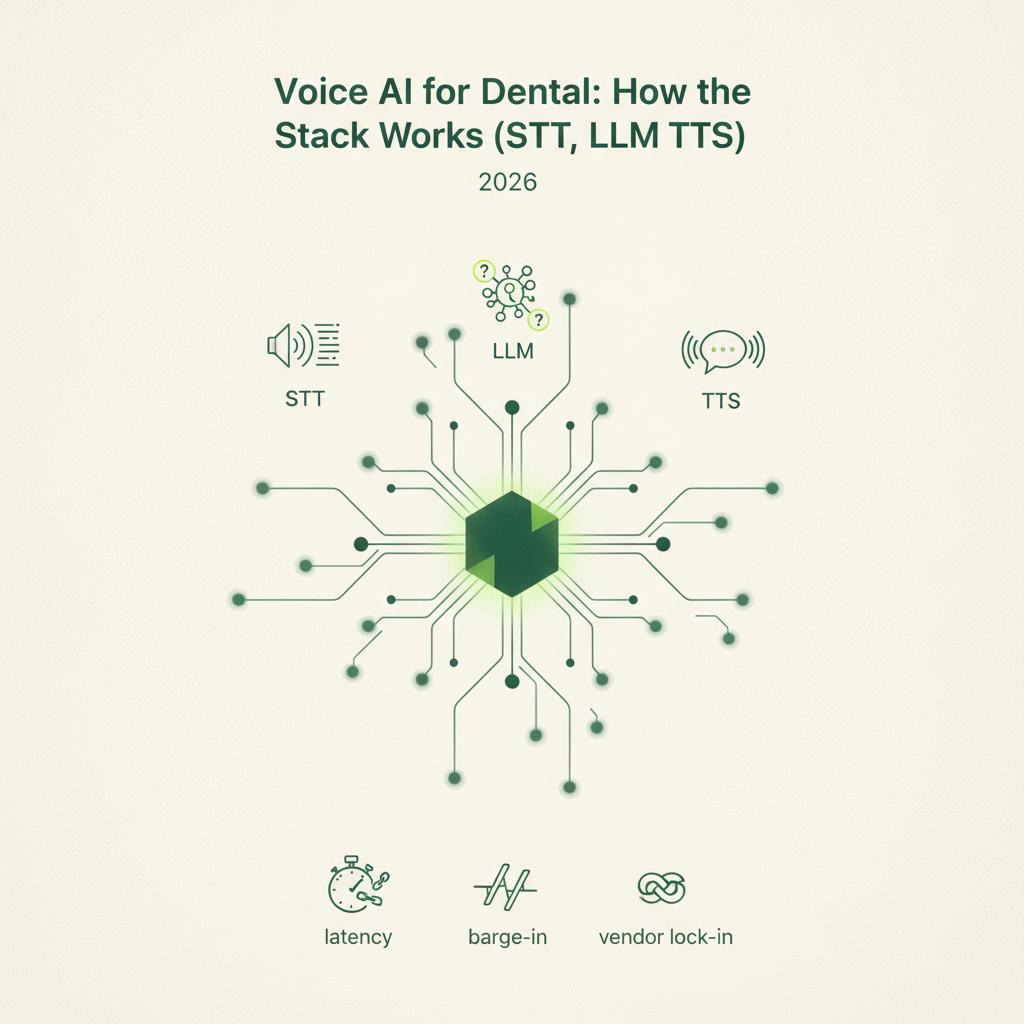
Every dental AI phone call — inbound reception, outbound recall, a payer status check — runs through the same basic pipeline: speech-to-text converts the caller's audio into words, a language model interprets those words and decides what to do, and text-to-speech converts the response back into audio. What separates a voice AI product that feels natural from one that feels obviously robotic isn't usually which specific vendor sits at each stage — it's latency and interruption handling. This is the technical breakdown of how the stack actually works, written for a practice owner who wants to understand what they're evaluating, not just be told to trust the demo.
Key takeaways
- The voice AI pipeline has four stages: speech-to-text, language understanding and action, text-to-speech, and telephony.
- Total round-trip latency under roughly a second reads as natural; latency above that and callers start talking over the response.
- Barge-in handling — letting a caller interrupt mid-sentence — is a specific engineering capability, not automatic.
- A provider-agnostic architecture protects against any single vendor's outage or price change.
- Accuracy on dental-specific vocabulary and accents varies meaningfully between speech-to-text providers.
- The action step — what the system actually does with what it understood — is where the real engineering differentiation lives.
Contents
- The four-stage pipeline
- Stage 1: telephony
- Stage 2: speech-to-text
- Stage 3: language understanding and action
- Stage 4: text-to-speech
- Why latency is the whole ballgame
- Barge-in: the tell that separates good from robotic
- Why provider-agnostic architecture matters
- Accuracy on dental-specific speech
- How to actually test a voice AI stack
- How Omnira's voice stack is built
- Frequently asked questions
- The bottom line
The four-stage pipeline
Every real-time AI phone conversation moves through the same four stages, each running in a fraction of a second, chained together into what feels — when done well — like a single, continuous conversation.
Stage 1: telephony
The call arrives, typically forwarded from the practice's existing number so the caller sees no visible change. This layer handles call routing, recording, and a clean handoff to a human line when needed. Telephony infrastructure is largely commoditized; it's rarely where quality differences show up.
Stage 2: speech-to-text
The caller's audio gets transcribed into text in real time, continuously, so the system can start processing before the caller has even finished. This is where background noise, accents, and domain-specific vocabulary create the most variance between providers — a subscriber ID rambled off quickly or dental terminology can trip up an engine tuned mostly on general conversational speech.
This is also where mishearing creates the most consequential downstream errors — a mis-heard digit propagates through every later stage, because the model is reasoning about what it was told it heard, not what was actually said.
Stage 3: language understanding and action
The transcribed text, combined with conversation history and context, gets interpreted to determine intent — and then something has to actually act on it: query availability, create an appointment, look up a balance, escalate.
This is where the real engineering differentiation actually lives, more than raw speech quality. A system with excellent speech but shallow action capability produces an articulate assistant that still can't book correctly. The distinction between holding a conversation and finishing a task is entirely a Stage 3 property.
Stage 4: text-to-speech
The response converts from text back to spoken audio. Modern speech synthesis is genuinely excellent — the tell, when there is one, is almost always timing rather than tone.
Why latency is the whole ballgame
Total round-trip time — from when a caller stops speaking to when the response starts playing — is the single biggest determinant of whether a conversation feels natural. Delays beyond roughly a second read as awkward silence, triggering a human reflex: the caller starts talking again, right as the delayed response begins, producing the talking-over-each-other pattern that signals "this is a machine" faster than any accent ever would.
Every stage contributes to this total latency, and a system is only as fast as its slowest link.
Barge-in: the tell that separates good from robotic
Barge-in is the ability for a caller to interrupt mid-sentence and have the system actually stop and listen. A system without real barge-in either ignores the interruption and keeps talking, or has an obvious, unnatural pause before registering the change.
This requires the system to listen continuously even while speaking, and to abandon a response mid-generation the instant a genuine interruption is detected. Testing barge-in directly — interrupting a demo call deliberately — is one of the fastest ways to separate a genuinely well-engineered system from one that only sounds good on a clean script.
Why provider-agnostic architecture matters
A system built around one specific speech vendor with no abstraction layer is fully exposed to that vendor's outages, pricing changes, and quality regressions.
A provider-agnostic architecture protects against this concentration risk and allows swapping in a better-performing provider later without rebuilding the system. This is invisible to a buyer, but worth asking about, because it's the difference between a vendor who can route around a bad outage and one stuck waiting.
Accuracy on dental-specific speech
Dental terminology, unusual names, insurance IDs rattled off quickly, and regional accents all stress speech-to-text accuracy differently than general conversational speech. A system that performs beautifully on a clean demo can degrade on a real call with background noise or a long alphanumeric ID under time pressure.
The practical test: call a demo line and deliberately give it the hard cases — mumble slightly, provide a long ID, use an uncommon name.
How to actually test a voice AI stack
- Call it and interrupt it mid-sentence, deliberately, more than once.
- Give it a long, awkward piece of information and see if it confirms correctly.
- Ask it something genuinely off-script and see whether it hands off gracefully.
- Ask directly what happens if their speech or language provider has an outage.
- Listen specifically for the pause length after you finish speaking.
How Omnira's voice stack is built
Omnira Dental is an AI-native operating system for dental practices — a single platform where six specialized AI agents run the practice's daily operations under human control: Luna (the orchestrator you talk to), Stella (scheduling and recall), Vera (billing and revenue cycle), Relay (patient communications and voice), Aria (clinical support), and Otto (operations, inventory, and analytics). Instead of bolting AI features onto legacy software, Omnira replaces the practice-management system itself, so the receptionist, the biller, and the chart share one brain and one ledger.
Relay's voice capability is built on a real-time orchestration layer with continuous listening for barge-in, paired with a deliberately provider-agnostic architecture for speech components — so no single vendor's outage is a single point of failure. Because Stage 3 runs against Omnira's own shared data layer rather than a disconnected system, the "can it actually finish the task" gap closes structurally: Relay books into the same scheduling engine Stella runs and verifies against the same benefits data Vera maintains.
Frequently asked questions
What is the technology stack behind AI phone systems for dental practices? A four-stage pipeline: telephony, speech-to-text, language understanding and action, and text-to-speech, chained together into a continuous conversation.
Why do some AI phone calls feel robotic even with good voice quality? Almost always latency and interruption handling, not voice quality. A delay before the response starts, or the system talking over a caller, breaks the natural rhythm of conversation.
What is barge-in in AI voice technology? The ability for a caller to interrupt mid-sentence and have the system stop and listen, requiring continuous listening and the ability to abandon a response mid-generation.
How much latency is acceptable in an AI phone conversation? Round-trip latency under roughly a second generally reads as natural. Beyond that, callers tend to start talking again, producing an awkward pattern.
Why does provider-agnostic architecture matter for dental voice AI? A system built around a single vendor is fully exposed to that vendor's outages. Provider-agnostic design allows swapping components without a rebuild.
How can I test whether a dental AI phone system is actually well-built? Call it and interrupt it mid-sentence, give it an unusual piece of information, ask something off-script, and pay attention to pause length.
The bottom line
The technology behind dental voice AI has largely converged on similar underlying components across vendors — the differentiation that matters isn't which specific speech provider sits where, it's the engineering discipline around latency, interruption handling, and what the system can actually do once it understands what a caller wants. Test the messy cases, not the clean ones.
Want to hear the difference latency and barge-in handling make? Call Relay's demo line and interrupt it on purpose — that's the actual test.