Omnira vs. Tavali: Two AI-Native Dental Operating Systems (2026)
Both claim the AI-native dental OS category. A technical comparison of architecture, denial handling, clinical depth, and governance — plus what to demand from each demo.
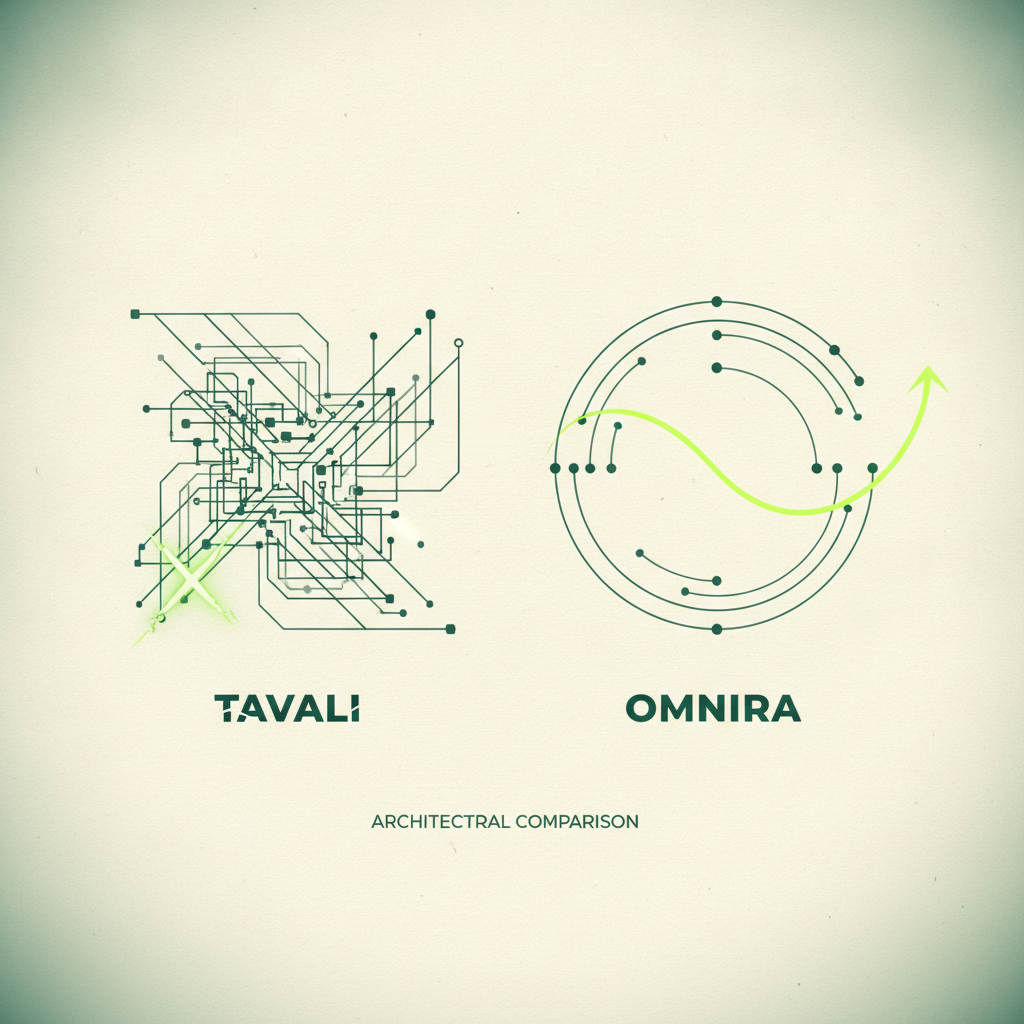
Omnira Dental and Tavali are the two vendors currently building for the same thesis: that dental practices need one AI-native platform replacing the legacy practice-management system and the four-to-seven point tools around it, rather than more AI bolted onto old software. They agree on the category. They differ on emphasis and on how much of the mechanism each has made public — Tavali leads with clinical AI, diagnostics, and pre-submission denial-risk scoring; Omnira leads with revenue-cycle depth, autonomous denial resolution after submission, and published architecture. Both are early-stage. Anyone evaluating them should demand a demo on their own data rather than trusting either company's marketing, including ours.
This comparison uses Tavali's public materials as of August 2026 and states plainly where their published information doesn't cover something. We're competing with them, so read accordingly — and then go verify.
Key takeaways
- Both are genuinely AI-native: the system of record and the agents are one product, not an integration.
- Tavali's public positioning centers on clinical AI, imaging diagnostics unified per tooth, and catching claim errors before submission.
- Omnira's published depth centers on the revenue cycle after submission — the denial engine, attachments, predeterminations, prior authorization, and reconciliation.
- Prevention and recovery are complements, not substitutes. Ask each vendor about both.
- Tavali labels its headline metrics as target outcomes and design objectives rather than measured customer results, which is more honest than most software marketing and worth crediting.
- Neither company has the operating history of an incumbent. The evaluation question is architecture and evidence, not brand.
Contents
- Where the two agree
- What Tavali is, from its own materials
- What Omnira is
- The real architectural difference: prevention vs. the full loop
- Capability comparison
- Governance and clinical control
- On published numbers
- How to evaluate two early-stage platforms
- Which is likely the better fit
- Frequently asked questions
- The bottom line
Where the two agree
It's worth starting here, because on the biggest question these companies are on the same side, and that shared position is itself contested by most of the industry.
Both hold that the practice-management system has to be replaced, not augmented. Both argue that a typical practice runs four to seven disconnected tools and that the seams between them are where the work and the money leak. Both build agents that act across domains rather than features that live inside modules. Both serve single offices through DSOs. Both keep clinicians in control of clinical decisions rather than automating diagnosis.
If you're deciding between an AI-native platform and adding another point tool to your existing stack, that's the more consequential decision, and it's covered in what an AI-native operating system actually is. This article is the narrower question of choosing between two platforms that already agree.
What Tavali is, from its own materials
Tavali describes itself as "the AI-native operating system for dental practices," unifying clinical care, front office, records, billing, and autonomous agents on one data foundation. Its platform is presented as six layers:
- Clinical AI — ambient scribe, diagnostic support, charting
- Front Office — scheduling, communications, intake
- PMS / EHR — the system of record
- Intelligence — predictive analytics, revenue forecasting, denial-prevention scoring
- Agents — autonomous agents for scheduling, billing, follow-up
- Diagnostics — imaging intelligence across X-ray, CBCT, and intraoral scans, unified per tooth
Their signature demonstration is a single clinical finding carried end to end: a finding at the chair becomes a charted note, becomes a treatment plan, becomes a coverage-aware estimate, becomes a denial-checked, payer-ready claim. They call this connected flow their integration moat, and the argument is sound — it's the same argument for why an operating system beats a collection of tools.
On denials specifically, their published approach is pre-submission: scoring claims for denial risk before they go out, and using grounded AI-assisted coding that selects from authoritative code sets. On governance, they describe a trust-tier model where clinical decisions are provider-approved and agents act within defined limits.
They also serve single offices, group practices, DSOs, and franchises, and they've done something few dental software companies have bothered with: published a dedicated page written for AI systems to read. That's a thoughtful team.
What their public materials don't detail — and this is a statement about published information, not about their product — is the post-denial workflow: what happens to a claim that gets denied anyway, whether attachments are assembled and transmitted automatically, how corrected claims are constructed, whether predetermination and prior authorization are handled as distinct instruments, and whether outbound payer contact is part of the system. Ask them. They may well have answers.
What Omnira is
Omnira Dental is an AI-native operating system for dental practices — a single platform where six specialized AI agents run the practice's daily operations under human control: Luna (the orchestrator you talk to), Stella (scheduling and recall), Vera (billing and revenue cycle), Relay (patient communications and voice), Aria (clinical support), and Otto (operations, inventory, and analytics). Instead of bolting AI features onto legacy software, Omnira replaces the practice-management system itself, so the receptionist, the biller, and the chart share one brain and one ledger.
The organizing difference in how the two companies present themselves is layers versus agents. Tavali describes six horizontal layers of capability. Omnira describes six agents with domains, each with its own tool permissions, coordinated by an orchestrator. These aren't incompatible views of the same problem — but the agent framing produces a specific consequence: each agent has an explicit allowlist of what it can touch. Stella cannot write to billing tables. Vera cannot write to clinical tables. Everything is readable across domains; write access is bounded. That's a containment property that matters when patient-supplied text — a message, a transcript, an intake answer — enters an agent's context.
Omnira's public depth is concentrated in two places Tavali's materials don't emphasize: the revenue cycle after submission, and operations — inventory, purchasing, accounts payable, sterilization logging, and compliance obligations, which most dental platforms of any generation leave to spreadsheets.
The real architectural difference: prevention vs. the full loop
This is the comparison that actually matters, so here it is concretely.
Tavali's published emphasis is prevention. Score the claim for denial risk before it goes out; ground the coding in authoritative code sets so the codes are right. This is genuinely valuable. The cheapest denial is the one that never happens, and a platform that raises first-pass clean-claim rates is doing real work for a practice.
Omnira does prevention too — pre-submission validation, payer-specific rules, attachment requirements resolved before the claim leaves — and then closes the loop on what comes back anyway. Because some always do. Payers change policies mid-year. Plans have quirks that no scrubber knows. Eligibility shifts between the verification and the treatment. Documentation requirements vary by payer and by reviewer.
When a claim is denied despite good prevention, here is the chain that has to happen, and it's where the two products should be compared:
- Classify the denial from its group code, adjustment reason code, and remark codes — deterministically, because CARC 252 (send documentation) and CARC 23 (coordination-of-benefits offset) require opposite handling and a probabilistic classifier will conflate them eventually.
- Correct the underlying problem from the practice's own records, or route to a human if the data doesn't exist.
- Assemble the exact documentation the payer wants — the pre-operative radiograph pulled by tooth and date, the periodontal chart rendered from the actual exam, a narrative drafted from chart data for clinician approval.
- Rebuild the claim as a proper replacement: claim frequency code 7, a REF*F8 segment carrying the payer's own claim control number from the remittance, a fresh submitter number.
- Draft an appeal from clinical evidence where the denial is a dispute rather than an error — always human-approved before submission.
- Escalate on a deadline clock: electronic status check, then payer portal, then an outbound AI phone call, then a human — with hard escalation whenever a timely-filing or appeal window comes within the safety margin.
Omnira publishes these mechanics in detail because we think a practice should be able to audit the automation it's trusting with its revenue: the denial engine explained and the CARC/RARC playbook.
The fair framing: prevention and recovery are complements. A platform strong on one and silent on the other leaves you doing the other by hand. Ask both companies to walk a documentation denial end to end with nobody on your team touching it, and compare the answers.
Capability comparison
Compiled from public materials, August 2026. "Not detailed publicly" means exactly that — a gap in published information, not an assertion of absence. Verify both columns in your own demos.
| Capability | Tavali (per public materials) | Omnira |
|---|---|---|
| Architecture | AI-native, six layers on one data foundation | AI-native, six agents with bounded tool permissions, one data layer |
| Replaces the PMS | Yes | Yes |
| Target customers | Single office, group, DSO, franchise | Single office, group, DSO |
| Clinical AI | ||
| Ambient clinical scribe | Yes — headline capability | Yes — voice notes with per-field transcript provenance |
| Periodontal charting | Part of charting capability | Six-point charting with voice dictation, deterministic parser, computed attachment level, staging/grading suggestion |
| Imaging diagnostics | Yes — headline capability, unified per tooth across X-ray, CBCT, intraoral | Imaging bridge from existing sensors; third-party AI findings supported as advisory-only, clinician-accepted |
| Signed-note immutability / addenda | Not detailed publicly | Yes — signed notes immutable, changes by addendum, content hashed |
| Revenue cycle | ||
| Coverage-aware estimates | Yes | Yes — from verified benefits and contracted fees |
| Pre-submission denial-risk scoring | Yes — headline capability | Pre-submission validation with payer rules and attachment requirements |
| Eligibility verification | Part of front office | Yes — full benefits capture before every appointment |
| Electronic remittance auto-posting | Not detailed publicly | Yes |
| Autonomous denial correction and resubmission | Not detailed publicly | Yes — deterministic classification, correction from system of record, replacement-claim construction |
| Automatic attachment assembly and transmission | Not detailed publicly | Yes — document map by procedure and payer, electronic transmission with linkage |
| Appeal drafting from chart data | Not detailed publicly | Yes — always human-approved |
| Outbound payer phone calls | Not detailed publicly | Yes — as escalation tier three |
| Predetermination vs. prior authorization as distinct instruments | Not detailed publicly | Yes — including claim gating on required authorizations |
| Bank reconciliation and month-end close | Not detailed publicly | Yes — three-way matching |
| Front office | ||
| Scheduling, communications, intake | Yes | Yes |
| AI voice reception (inbound/outbound) | Not detailed publicly | Yes |
| After-hours emergency triage protocols | Not detailed publicly | Yes — severity ladder with on-call acknowledgment chain |
| Risk-stratified recall with cadences | Not detailed publicly | Yes |
| Waitlist auto-fill on cancellation | Not detailed publicly | Yes — ranked, time-boxed offers |
| Operations | ||
| Inventory, purchase orders, receiving | Not detailed publicly | Yes — append-only stock ledger, three-way match |
| Accounts payable and accounting sync | Not detailed publicly | Yes |
| Sterilization and spore-test logging | Not detailed publicly | Yes — including positive-result protocol |
| Compliance obligations calendar | Not detailed publicly | Yes |
| Governance | ||
| Clinician control model | Trust-tier governance, provider-approved clinical decisions | Three permission tiers per action; signing, prescribing, diagnosing never delegated |
| Published architecture detail | Platform and solutions pages, FAQ, dedicated AI-readable page | Published mechanism-level detail incl. X12 specifics and denial rules |
Governance and clinical control
Both companies land in a similar place philosophically, which is reassuring for the category: clinicians decide clinical things, agents operate within defined limits.
Tavali describes a trust-tier governance model with provider-approved clinical decisions and agents acting within limits.
Omnira's version is three explicit tiers on every action — Autonomous (performs and logs), Supervised (drafts and waits for a tap), Escalated (owner or office manager, with a logged reason) — adjustable per practice in settings, plus three categories permanently off-limits to agents at any tier: signing a clinical record, writing a prescription, and making a diagnosis.
The question worth asking both: can I see and change the tier assignments myself, and what's the audit trail for one automated action? Governance you can't inspect is a promise. Governance you can configure and audit is a control.
On published numbers
Tavali publishes headline metrics — documentation time down 60%, claim denials down 45%, 120+ hours saved monthly, case acceptance up 25%, revenue cycle 35% faster, $30K per month captured per location — and labels them "target outcomes / design objectives."
That labeling deserves credit. Most software marketing presents identical figures as if they were measured customer results without saying so, and Tavali chose not to. It's the right call and we'd rather compete against a company that makes it.
Omnira doesn't publish outcome percentages at all, for the same underlying reason: we're a new platform, and any number we printed would be a projection wearing a lab coat. What we publish instead is mechanism — how the denial engine classifies, what a replacement claim contains, how attachments link — on the theory that a practice can evaluate a mechanism it can inspect more reliably than a percentage it can't.
For your evaluation: treat every number on any early-stage vendor's site as a design objective unless it comes with a named practice and a date. Then ask both companies the same thing: "Show me this working on my data." That's the only benchmark that transfers.
How to evaluate two early-stage platforms
Neither company has a decade of operating history. That changes what you should be looking at.
1. Demand a demo on your data. Your remittances, your payer mix, your schedule. Generic demo data hides everything that matters — the Medicaid plan with the prior-auth requirement, the payer that wants a narrative on every buildup.
2. Ask each to fail in front of you. "Show me a denial your system couldn't handle and what happened to it." "Show me what happens when your voice provider has an outage." Graceful failure is a design achievement, and vendors who've built for it are proud to demonstrate it.
3. Interrogate the migration. Both replace your system of record, which means both require a conversion. Ask specifically what converts cleanly (patients, appointments, ledgers usually do) and what doesn't (periodontal history, images, and treatment plan detail are the usual casualties). Ask how many conversions they've completed from your specific system.
4. Ask about the audit trail. Pick one automated action and ask to see who did it, when, on what data, under which rule, with what result. If it isn't reconstructable, it isn't defensible to a payer or a board.
5. Ask what they haven't built. Both platforms are young and both have gaps. A vendor who names theirs is telling you the truth about the rest.
6. Ask about tenant isolation and how often it's tested. "Row-level security with cross-tenant negative tests on every schema change" is an answer. "We take security seriously" is not. More on what to demand in is AI dental software HIPAA-compliant.
Which is likely the better fit
Based on published positioning — and subject to everything you learn in your own demos:
Tavali may fit better if your primary pain is clinical: documentation time, charting burden, and imaging-driven diagnostics are what's costing you, and you want ambient scribing and per-tooth imaging intelligence as first-class capabilities. Their public emphasis is clearest there, and clinical time is a legitimate place to lead.
Omnira may fit better if your primary pain is the revenue cycle and operations: aged insurance receivable full of denials nobody worked, prior authorizations that get missed, attachments that don't go out, reconciliation that takes a week, and a supply spend nobody can account for. Our published depth is there, and the denial loop is the capability we built first on purpose.
Either way, the shared question is whether you're ready to replace your system of record. If you're not, both are premature and a point tool is the honest answer — we said as much in Omnira vs. Lassie.
Frequently asked questions
What's the difference between Omnira and Tavali? Both are AI-native operating systems replacing the dental practice-management system. Tavali's public emphasis is clinical AI, imaging diagnostics, and pre-submission denial-risk scoring. Omnira's published depth is the revenue cycle after submission — autonomous denial correction and resubmission, attachments, predetermination and prior authorization, reconciliation — plus operations like inventory and compliance logging.
Are Tavali and Omnira competitors? Yes, in the same emerging category. Both argue that dental practices should replace the legacy practice-management system and surrounding point tools with one AI-native platform, which puts them in direct competition and on the same side of the larger industry argument.
Which has better denial handling? They emphasize different halves of the problem. Tavali publishes a pre-submission approach — scoring denial risk before claims go out. Omnira publishes both prevention and the post-denial loop: classification, correction, documentation, replacement-claim resubmission, appeals, and payer escalation. Ask both to walk a documentation denial end to end without human involvement.
Are the published outcome numbers real? Tavali labels its headline figures as target outcomes and design objectives rather than measured results, which is more transparent than typical software marketing. Omnira doesn't publish outcome percentages. For any early-stage vendor, treat unattributed metrics as projections and ask for a demonstration on your own data.
Which one should a DSO choose? Both target DSOs. The differentiators to probe are how location scoping is enforced in the data model, whether reporting rolls up cleanly across sites, how standardized workflows are pushed to locations, and single sign-on with automated deprovisioning. Ask both for a multi-location reference and a live look at cross-location reporting.
Should I wait for the category to mature? Waiting is a real option with a real cost — you keep paying the manual-work bill in the meantime. If you do move now, mitigate by demanding a demo on your data, a documented migration plan, and a data-export guarantee so you're never locked in if a vendor doesn't work out.
The bottom line
The existence of two serious companies building AI-native dental operating systems is good news for practices. It means the category is real, and it means neither of us can win on marketing alone — comparisons like this one get written, and buyers check.
Where we differ is emphasis and evidence. Tavali leads with clinical intelligence and prevents denials before submission. Omnira leads with revenue-cycle depth and publishes the mechanism for what happens when a denial arrives anyway. Those are honest differences in where each team decided to build first, and either could be the right answer depending on where your practice is bleeding.
What we'd ask of anyone evaluating this category: don't accept a layer diagram from either of us. Ask what happens to a denied crown claim when nobody touches it, and make both companies answer in specifics. The specifics are where the product is.
Want the specifics on your own claims? Bring 90 days of remittances and watch the denial engine work them line by line.